
In the second part of the Legacy Series, we’ll dive into the three remaining members of the modern AL East. One is a perennial powerhouse with dominance over and over. One is a new guy still trying to hack it with the big boys. And the last has proved their worth, but wants more.
New York Yankees
Early Years
As mentioned in Part 1, the history of New York begins down in Baltimore. In 1903, the American League charter team started in Baltimore was bought out by Frank Farrell and Bill Devery for $18,000. The pair immediately moved the team to Manhattan and renamed them the New York Highlanders.
In late April, the Highlanders lose their opening game at Washington, but immediately reach .500 with a win over Washington the next day. The Highlanders post a 72-62 in their inaugural year, 14 games back of the Boston Americans.
In 1904, New York would post their most competitive season of their first 18 years of existence when they challenged Boston for the AL pennant, eventually failing, 1.5 games out of first place.
This year featured the incredible pitching of Jack Chesbro when he went 41-12 in 55 games. He threw 48 complete games! His 41 wins is a modern day record.

April 1912 and 1913 morph the Highlanders into one of the most recognizable teams in all of sport today. In ’12, the iconic Pinstripes first appear, with the Yankee moniker appearing the following year. The Pinstripes don’t get a warm welcome by the organization, leading the Highlanders to their worst performance in franchise history at 50-102.
Murderer’s Row
Having just completed the most memorable trade in sports history, the Yankees are finally ready to compete for World titles. In his first two years in New York, the Babe slugs 113 homeruns. Starting in 1921, with Babe at the helm, the New York Yankees go back-to-back-to-back as the AL Champion, facing the New York Giants in all three World Series. In 1921 and 22, the Giants get the best of the loaded Yankees.
However, in 1923, Yankee Stadium opens with a 4-1 win over Boston. Things immediately look up for this team. They start the year 4-0 and never fall below .500. Their longest win streak (9) triples their longest losing streak (3). The Great Bambino dominates the field and is awarded his only MVP. The Yanks once again take the AL Pennant, by a staggering 16 games. And, once again, they face the crosstown rival Giants. Finally, the Yankees break through and post a 4-2 World Series victory.
New York falls back to Earth in 24 and 25. But someone special takes the field in a pinch-hitting situation on June 1, 1925. Lou Gherig begins his 2,130 consecutive game appearances with a pinch-hit fly out to left field, the next day taking over starting first baseman duties.
Joining Babe and Gherig, Tony Lazzeri, Bob Meusel and Earle Combs combine to form the famous Murderers’ Row, known for their exceptional hitting ability which comes to full fruition in 1927. The ’26 Yankees reached the World Series but lose the seven game series to St. Louis.
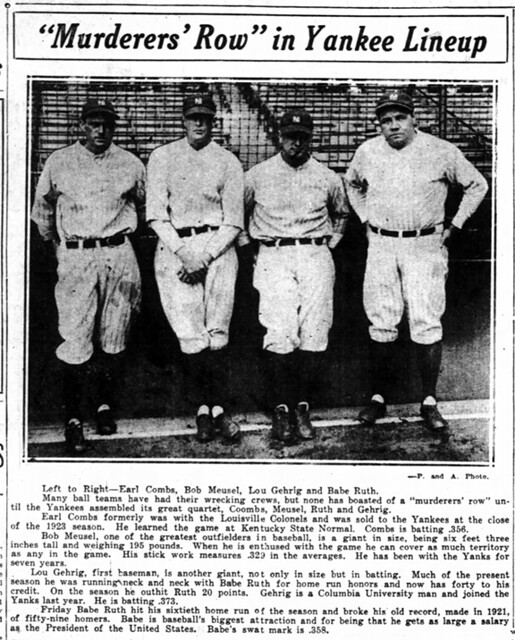
In ’27, they would power their way through the American League with a .307 average, .489 slugging, and by outscoring their opponents by 376 runs. They finish 19 games ahead of second place Philly. Lou Gherig is awarded MVP for his .373/.474/.765 slash, 47 home runs, and 173 RBI. Meanwhile, Bambino only rocked 60 home runs himself, more than any other AL team. The Yankees plow through Pittsburgh in a World Series sweep, the franchise’s second.
New York followed that performance up with a third consecutive AL pennant and another World Series sweep in 1928.
Pure Dominance
Tragedy struck in 1929, when the Yankees’ 11 year manager, Miller Huggins, dies in the midst of the season. New York would find itself mired in a woeful 6 of 7 year span without an AL title. The one year they did win the AL, they also swept the Cubs in the World Series.
Babe Ruth leaves New York in 1935, but in the very capable hands of Gherig, who is shortly joined by rookie Joe DiMaggio in 1937.
From ’35-’43, New York dominates the sport with four consecutive World Series titles including back-to-back sweeps of the Cubs and Reds in ’38 and ’39. The Yankees finish no worse than 3 games back of first place in that 9 year stretch, winning the AL pennant 7 of 9 years. DiMaggio wins MVP twice before heading off to serve as a morale booster for the military from 1943-1945.
Following The War, the Yankees regained their stranglehold on the sport with 6 World Series wins in 7 years with five straight from 1949-1953. Mickey Mantle and Yogi Berra join the stable being built up in New York, collecting 6 MVP awards from 1951-1962. Mantle added a Triple Crown year in 1956 (.353, 52 HRs, and 130 RBI).
Not So Dominant
After losing back to back World Series in ’63-’64, New York regresses for the next 11 years. The Yankees finish at the bottom of the AL in 1966 and enter the AL East with 7 straight seasons without a Divisional Pennant.
After managing the Yankees to the World Series in back-to-back-to-back years, winning in ’61 and ’62, Ralph Houk is brought back to manage the team in 1967. He guides the Yankees to 4 winning seasons in his 7 years back with the club, but does not make the postseason.
In 1976, after losing to Cincinnati in the World Series, the Yankees sign Reggie Jackson and his impact is immediately felt as he propels New York to the World Series. Reggie hit three home runs in game six to take the Series over the Dodgers and claim the franchise’s 21st Title. The Yankees repeat in ’78, once again beating the Dodgers in six games.
However, the Yankees would then enter another middling-period as they made the post-season only twice from 1980 to the strike-shortened 1994 season. Interestingly, the Yankees find themselves in a contentious dispute with Kansas City during the 1983 season.
On July 24 of that year, the two teams face off in what became known as the “Pine Tar Game.” In the ninth inning, KC was trailing 4-3 with a runner on first. Up stepped George Brett. He walloped a ball over the fence to give the Royals a 5-4 advantage. After Brett rounded the bases, the umpire inspected Brett’s bat due to a complaint by Yankees’ manager Billy Martin. Sure enough, the ump found “excessive pine tar” on Brett’s bat. Brett was ruled out due to the infraction and the Yankees were awarded the victory.
The Royals would go on to protest the game and won their appeal, forcing the game to be resumed August 18. The Royals would end up winning 5-4. Much-ado-about-nothing.
Resurgent Yanks
After the strike in ’94, the Yankees would enter their modern-day perennial contendership status. From ’95-2024, New York has missed the post-season only 5 times, adding to their collection of post-season hardware with 5 World Series, 8 AL Pennants, and 16 AL East Pennants (including 9 straight). The Captain, Derek Jeter, closer, Mariano Rivera, and big power A-Rod highlighted many outstanding players the Yankees would rely on in their year-to-year contender role at the turn of the century. Managers Joe Torre and Joe Girardi would combine for 2,084 wins in their 22 years with the organization, never getting closer than 6 games over .500 from a losing season.
Now led by The Judge and Co., the Yankees look to compete for the World Series again as they faltered in last season’s series loss to the Dodgers.
| Award | # of Recipients |
| World Series | 27 |
| AL Titles | 41 |
| MVP | 24 |
| Cy Young | 6 |
| ROY | 10 |
| Manager of the Year | 3 |
Tampa Bay Rays
Tampa is one of the two youngest franchises in the game, alongside Arizona.
March 9, 1995, the latest expansion to MLB is made in a unanimous vote to bring Tampa Bay and Arizona to life. However, the history of baseball in Tampa Bay goes back much further than a 30 year old vote.
The Fight to Bring Baseball to the Gulf
In 1902, St. Petersburg played host to the semipro St. Petersburg Saints. While the Saints would fold and revive several times over the twentieth century, even winning 9 minor league titles, the team could never make the break into the majors and was closed for the final time after the 2000 season.

Major league baseball, however, visited St. Petersburg for the first spring training in the area when St. Louis’ Browns came to town in 1914. They quickly packed up and left, but, due to the city’s campaign, led by mayor Al Lang, to entice major league teams to the area, the Phillies held their spring training in St. Petersburg from 1915-1918. Since then, most every year saw Tampa Bay playing host to one or two spring trainings.
But, outside of the spring games, Florida could not entice any major league attention. When the league expanded in 1961, 62, 69, and 77, rather than add a team to the South East region, the league added 2 teams in Texas, 2 in Southern California, and added a second team to New York. (The league also expanded to Colorado, Seattle, Kansas City, Toronto, Milwaukee, and Washington D.C. but, not including Colorado and Seattle, each of these teams were expansions over 150 miles closer than Atlanta is from Tampa (456 miles))
Birth of a Devil Ray
But, in ’93, the league finally brought major league baseball to Florida when the Marlins opened their doors. As stated earlier, Tampa was awarded a franchise in ’95 to begin play in the ’98 season.
Adam Sisk became the first Devil Ray on September 26 1995.
In 1996, the Devil Rays begin play as a member of the Gulf Coast League losing their first game 10-1 in front of a raucous crowd. The Durham Bulls are born as an expansion minor league affiliate for the Devil Rays.
The Devil Rays become officially affiliated with the American League in 1997. The AL now has 15 teams to match Arizona’s addition to the NL.
In late ’97, Tampa steals Larry Rothschild from their Florida Marlins counterparts to become their first manager. The Devil Rays select 35 players in the Expansion Draft, then trade four of them for a selection of major league talent: Fred McGriff, Roberto Hernandez, Kevin Stocker, John Flaherty. Shortly after selling out their Opening Day in 17 minutes, Tampa signs free agent third baseman Wade Boggs.
March 31, 1998, the first game in Tampa Bay history is played in front of a sell-out 45,369 crowd. The Devil Rays drop the game 11-6, but a new team has officially been born to the world of baseball.
On April 19, the Devil Rays become the first expansion team to ever reach 4 games over .500 in their inaugural season. However, Tampa wouldn’t compete much later than that as they finish 63-99 and in dead last in the AL East.
Extracting the Devil out of Tampa
While the Devil Rays would host some memorable moments in baseball history: Wade Boggs reaching 3,000 hits with a home run August 7, 1999; Fred McGriff becoming only the second player in MLB history to bash 200 homers in both leagues on September 23, 2000; September 3 and 4th 2003 saw the first back-to-back complete game shutouts in Tampa history; the team would not seriously compete in the league until the 2008 season.
The Devil Rays would not finish with more than 70 wins throughout their ’98-’07 tenure. They did not leave the AL East cellar until 2004, to finish in fourth, but quickly relegated themselves back to the basement from 2005-07.
At the conclusion of the 2007 season, owner Stuart Sternberg and Co. finally relented on incessant pleading by fans to change the name of the team due to the “unseemly” connection to the Devil in Devil Ray (which is just the name of a type of ray). Rather than pick up a different ray as the team’s moniker, ownership simply dropped Devil from the name and the Rays were born.
The fans might’ve been right.
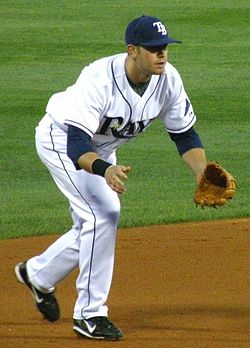
In 2008, the Rays, cleansed of their Devil, go last-to-first to win the AL East. The Rays’ starting battery all won at least 11 games on the year, Evan Longoria was a ROY sensation at third, and Tampa managed to keep Boston off their tail. The Rays beat the White Sox and the Red Sox to capture their first AL pennant and reach the team’s first World Series. However, Tampa would be denied by Philly.
A Tough Swim
The Rays plummeted back to middle of the pack in ’09, but would win the AL East in 2010, where they were ushered out of the postseason in five games by Texas. Tampa went to the postseason in 2011 and 13 but did not pass the Divisional Round either time.
After the 2013 season, the Rays faced four straight losing seasons and missed the postseason five years in a row. Despite climbing back from a 4-13 record in mid-April 2018, the Rays’ 90-72 record would not translate to anything better than third in the AL East.
The Rays made the World Series for their second and latest time in the Covid-shortened 2020 season, losing to the Dodgers in six games.
| Award | # of Recipients |
| World Series | 0 |
| AL Titles | 2 |
| MVP | 0 |
| Cy Young | 2 |
| ROY | 4 |
| Manager of the Year | 4 |
Toronto Bluejays
On August 12, 1976, the Blue Jays of Toronto were born. Toronto would join Seattle as the MLB’s two expansion teams for the 1977 season.
Baseball in Hockeyland
Toronto was not the first site of Canadian major league baseball, as the Montreal Expos had started up in 1969. However, Toronto did have a rich tradition of baseball, older than many sites of major league teams in the States.
In 1896, the Toronto Maple Leafs, not to be confused with the NHL team of the same name, were founded and played in the Eastern League. By 1902, the Eastern League was demoted to Class A ball, the step-down from the major leagues. The Leafs went on to win the Eastern League that year.

In 1912, shortly after Canada and the world were thrust into The Great War, the Providence Grays came to Toronto for a game that turned into a historic one. The pitcher for the Grays would shut out the Leafs, and even decided to embarrass them from the other side of the rubber with his first ever home run. That pitcher was none other than Babe Ruth.
As members of the International League, the Maple Leafs would climb the ranks of minor league baseball from Class-A to Double-A, and finally Triple-A. Toronto won minor league titles 10 times over their 71 year history in the minors. But the doors were closed following a depressing 802 fan ‘crowd’ in the final home game of the 1967 season.
A Roof for the Cold Days
Toronto was awarded their expansion franchise in March 1976 after an extensive project to build a compatible stadium and ensure the city was prepared for the financial impact the team would bring. The Blue Jays name was chosen on August 12 after 30,000 entries were added to the “Name the Team” contest.
Roy Hartsfield was named the first manager for the team, a second baseman for the Boston Braves 1950-52. His only management experience was in the minor league where he won the Pacific Coast League Championship in his last two seasons before joining the expansion.
Phil Roof, a catcher, became the first player for the Toronto franchise when he was purchased from the Chicago White Sox.
The White Sox came to town to open the ’77 season and were on the losing end of Toronto’s Opening Day 9-5 victory. But Hartsfield could not guide the Jays to anything close to a winning tradition as they finished in the bottom of the barrel each of his three seasons with the club, never winning 60 games.
Hartsfield was replaced by Bobby Mattick for the 1980 season, but the losing continued for both of his years with the club. In 1982, Mattick handed over the club to Bobby Cox, and the club improved! From 7th place to 6th. Then they improved again in ’83, stepping up to finish 4th in the AL East behind their first winning season as a franchise at 89-73. They would repeat that same record in ’84, good enough for a second place finish.
The 1985 team broke through to win the Division for the first time but were ushered out of the playoff by the Royals in a seven game ALCS.
Starks in Toronto
Following the ’83 season, the Blue Jays would see 11 straight winning seasons, winning the AL East five times.
In 1987, the team got their first MVP when George Bell posted a .308, 134 RBI, 47 homers season, and he wasn’t even the best graded Blue Jay, but the Jays would finish in second place behind the Detroit Tigers in the AL East.
After winning the division in 1989, the Jays would take over the crown of the AL East for four of the final five seasons of the 7 team division. In 1991, Toronto won the division but were denied a World Series appearance, losing the ALCS in five games. 1992 would be a different year for the club.
Having just dropped the 1989 ALCS to the Oakland Athletics in five games, Toronto was eager to get some revenge. After splitting the first two games in Toronto, the teams flew out west where some drama would unfold in Game 4. With a 2-1 series lead, the Jays were down 6-1 in the 8th inning. The Jays jumped on the A’s pen for three runs to take it to a 6-4 ninth inning against Dennis Eckersley. Roberto Alomar didn’t care he was facing one of the best closers of all time as he belted a two-run homer to keep Toronto’s World Series hopes afloat. The Jays would go on to win 7-6 in 11-innings and closed things out with a Game 6 9-2 win.
Toronto was finally going to the World Series.
The Jays would win the six game series over the Braves and bring home Canada’s first World Series title after posting four one-run wins, including an 11-inning Game 6.
Toronto would not bend the knee the following year, once again taking the AL East, this time by 7 games over the Yankees. The Jays took the ALCS from Chicago in six games and looked to repeat as Kings of the North when they met the Phillies. Offense was on display in the Series as the teams combined for 85 runs in the six games. A pivotal Game 4 saw the Jays down 12-7 and 14-9 before pulling ahead for a 15-14 victory. They would be shutout in the next game.
In Toronto, Game 6 started out strong for the Jays but came down to the ninth inning. Trailing 6-5 in the bottom of the ninth, the Jays sent Rickey Henderson to the plate. He would draw an inning-opening walk. Devon White would follow that with a fly out to LF. Paul Molitor delivered a one-out single to move Henderson into scoring position. Joe Carter stepped into the batters box and the greatest line in Toronto broadcast history was made:
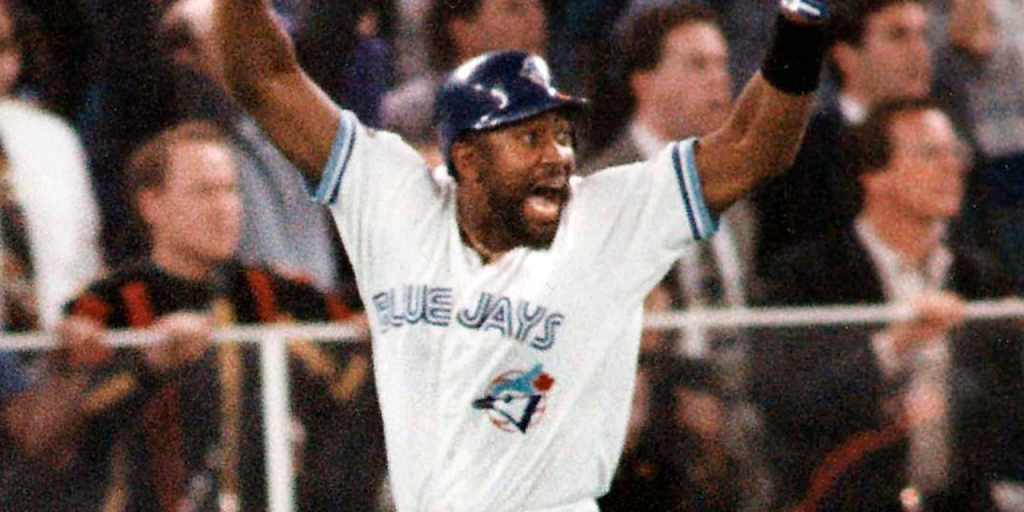
Touch ‘em all, Joe! You’ll never hit a bigger home run in your life!
The Blue Jays were back-to-back World Champions.
Kings No More
What followed the club’s second World Series has not been nearly as pretty, as their wings were clipped finishing under .500 the next four years. Toronto wouldn’t make another postseason appearance until 2015 when they won their first, and only, AL East title of the 21st century. Despite key offensive seasons from the likes of Josh Donaldson, Edwin Encarnacion, and Vladimir Guerrero Jr., the Jays have not been able to reach the World Series since their ’93 title.
| Award | # of Recipients |
| World Series | 2 |
| AL Titles | 2 |
| MVP | 2 |
| Cy Young | 5 |
| ROY | 2 |
| Manager of the Year | 0 |

 fromthefield2thepage.blog
#/media/File:1902_Toronto_Maple_Leafs.jpg)
Leave a comment